
Before contact
Object detection, tracking, pose estimation and visible geometry help a system locate things without touching them.
Physical intelligence • Robotics
Flexible tactile surfaces, sensitive readout electronics and signal processing can help robotic systems estimate contact conditions and respond to the physical world. Different sensor materials and architectures offer different trade-offs.
HOW CONTACT BECOMES DATA
Cameras help a machine locate objects; tactile sensors provide additional information about what happens during physical contact. Capacitive, resistive, piezoelectric and optical approaches can measure different aspects of touch, deformation or pressure distribution.
A sensing layer generates physical measurements. Signal-conditioning electronics and external processing interpret those measurements, estimate contact or slip patterns where appropriate, and inform the controller. No single sensing component independently creates a finished robotic grasping system.
Explore independent sensing research ↗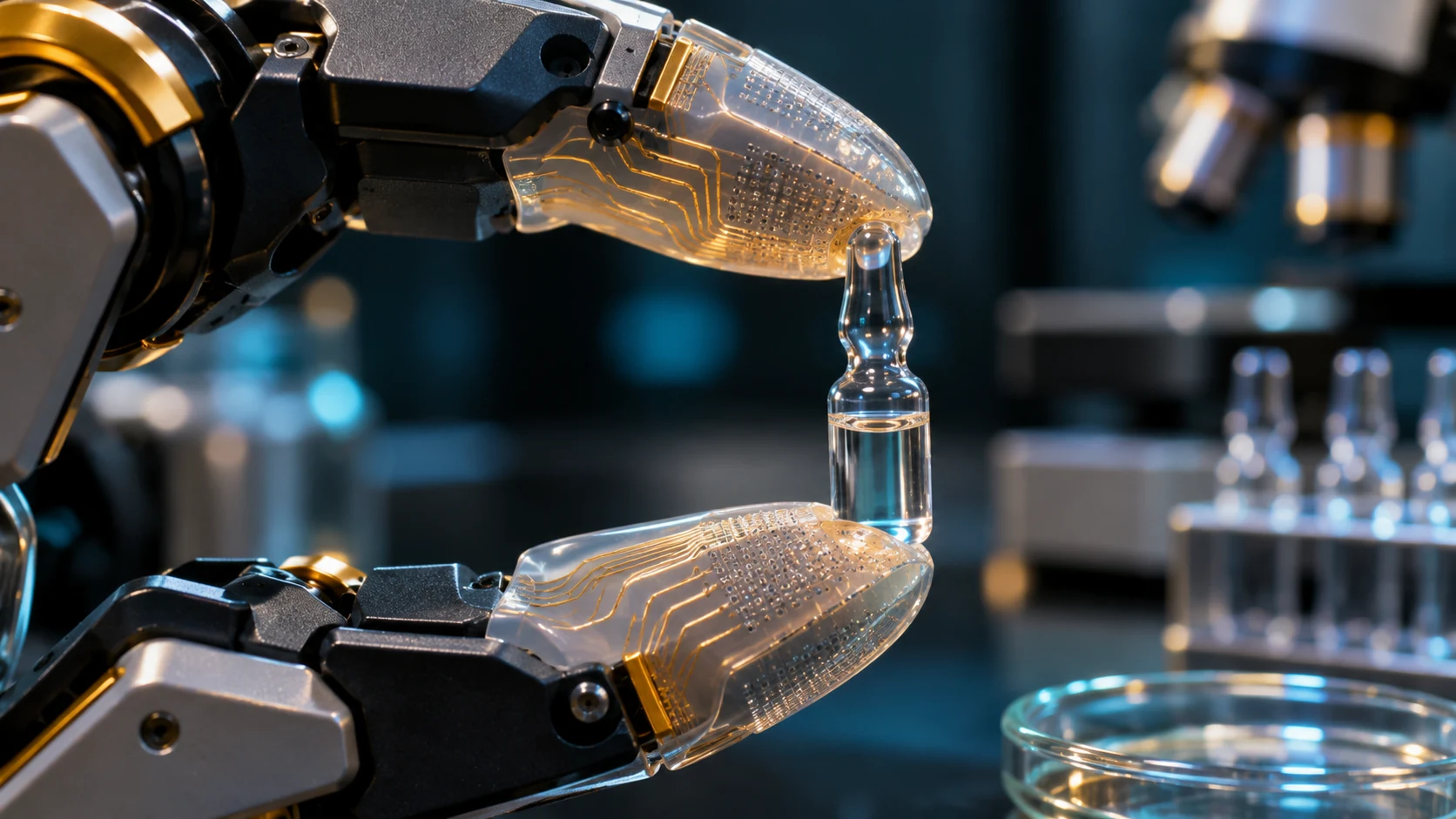
Sensor architectures vary by application. Reliability depends on materials, electronics, signal processing, testing and the surrounding system; no product performance is claimed here.
CAMERA + CONTACT SENSING
No sensor makes cameras obsolete across the board. They answer different physical questions and can work together.
Object detection, tracking, pose estimation and visible geometry help a system locate things without touching them.
Pressure distribution, local deformation, grip force and onset of slip give direct interaction signals that ordinary cameras cannot determine by themselves.
A processing and control loop interprets sensor arrays, combines signals where useful and adjusts the grip or interface. A digitizer alone is not a complete autonomous controller.
Interactive concept
Explore three hypothetical contact states on a ten-by-ten illustrative sensor grid. This is an educational visualization—not a measured signal, test result or simulation of any commercial product.
Conceptual contact states
Switch states to illustrate how changing contact patterns could become measurable digital signals.
Estimating forces or slip from tactile signals requires calibration, material characterization, suitable electronics and external processing.
BROADER APPLICATIONS
Tactile sensing research spans robotic hands, prosthetics, wearables, interactive surfaces and input devices. Each application needs its own materials, signal interpretation, safety considerations and validation.
Fine-grained contact data can help external processors determine pressure distribution and potential slip in gripper control loops.
Flexible sensor arrays may record movement, deformation or contact when combined with suitable electronics and safe material stacks.
Pressure-aware input devices can extend conventional touch into richer contact-based interactions, subject to full system integration.
A strategic digital identity
An independent category-relevant .com identity for a company, platform or new sensing venture.