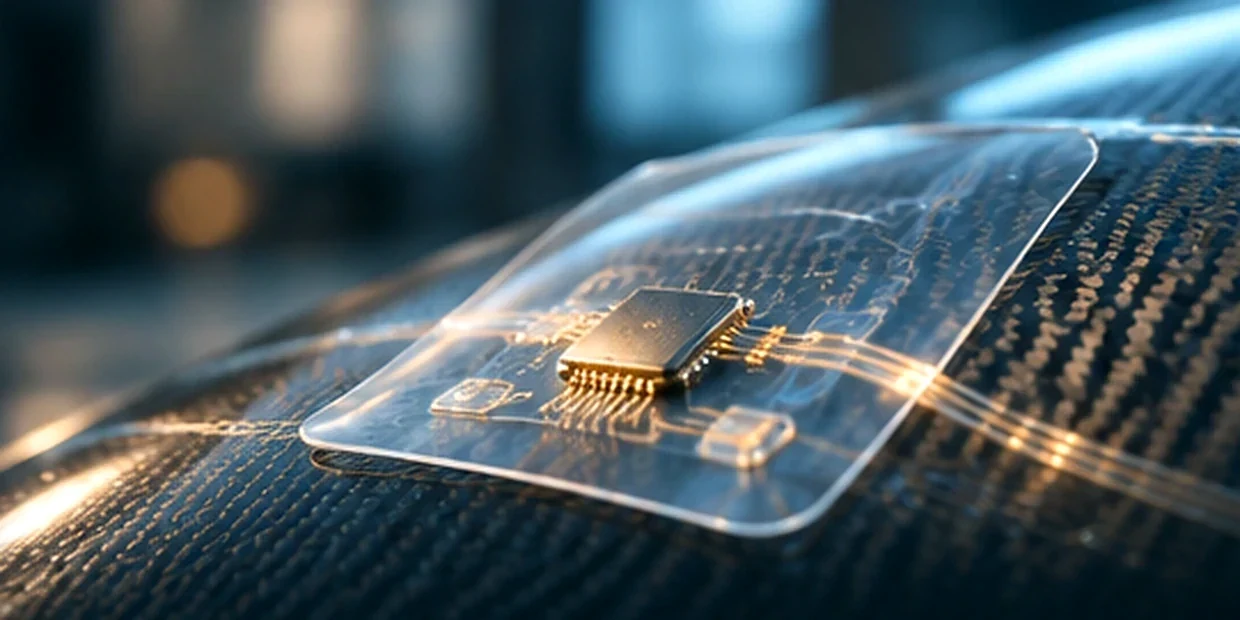
Why transparent sensing matters
A window, transparent panel, instrument cover or display-adjacent surface may already occupy the ideal sensing position. Adding a well-designed sensing layer can preserve line of sight while responding to touch, strain, temperature, environmental changes or an application-specific signal. The commercial advantage is integration: the object keeps its recognizable form and gains measured awareness.
The working stack
Practical systems combine a substrate, a sensing mechanism, electrical or optical contacts, passivation and a readout chain. Conductive meshes and patterned films offer one route; optical approaches may exploit changes in light transmission, coupling or scattering. The correct choice depends on the measurand and required transparency—not on a universal promise that every sensor can be invisible.
Where a company could build
Opportunities include interactive transparent surfaces, equipment windows with integrated condition information, unobtrusive optical interfaces, clear wearable materials and sensor-ready material components for OEM integration. A materials supplier could sell validated layers; an electronics platform might provide modules, calibration software and manufacturing processes.
What must be proven
Optical transmission and visual appearance must coexist with signal quality, adhesion, abrasion resistance, cleaning tolerance, sealing and repeatable manufacture. Transparent films that perform well on a flat lab coupon may fail after lamination, bending or years of surface exposure. Reliable sensing also needs a low-noise signal chain and calibrated outputs.